
Shipping Birch Panels Without Edge Damage
Edge failure is the primary risk in a birch panel shipment: the face typically survives the journey intact, but the edges do not. Dongstar Wood publishes the packing standard that addresses it — every export pack is wrapped, steel-strapped and mounted on a wooden pallet, with custom packaging and labelling for large projects — alongside face grades from A to C, thicknesses from 2.7 mm to 30 mm, and compliance options including E1, CARB P2 and CE documentation.
Key takeaways
- The published packing standard lists three elements: wrapping, steel strapping and a wooden pallet.
- Custom packaging and labelling are available for large projects, where handling is planned rather than improvised.
- Face grades run from A-grade, with some knots and burls allowed, through B and C to a repaired-defect grade.
- Every panel can ship with the certificate its market asks for — E1, CARB P2 or CE documentation — bonded with low-emission glue systems.
Why edges take the damage
A plywood panel is strong in the middle and vulnerable at the edges. The face is protected by the veneer and the film of glue on its surface; the edge is the exposed end of every veneer layer in the panel, and it is the part that meets the forklift tine, the container wall and the corner of the next pack. Damage at the edge is not cosmetic: it opens the veneer layers to moisture, and a panel that arrives with swollen edges arrives with a shortened life.
The failure sequence is predictable. Panels are stacked, strapped and lifted; the bottom panels carry the weight of the stack; the edges of the bottom panels take the pressure of the strapping; and the whole pack moves through a journey it cannot be protected from by the buyer. The packing standard is the only part of that sequence the buyer controls before the truck arrives, which is why it is the first thing to confirm in a birch order.
The packing standard the mill publishes
The product page names the standard directly: every export pack is wrapped, steel-strapped and mounted on a wooden pallet. The wrapping is the first barrier against handling damage and weather; the strapping holds the pack together so the panels cannot slide against each other; the pallet lifts the pack off the container floor and keeps the bottom panels out of the water that collects there. Each element does a different job, and a pack that skips one of them is missing the protection that element provides.
For large projects the page adds custom packaging and labelling. That option matters more than it sounds: a project pack that is labelled and dimensioned for the site can be handled with a plan, and a plan is what prevents the improvisation that causes edge damage. A Birch Plywood Supplier that publishes its packing standard gives a buyer something to check the arriving pack against; one that does not leaves the buyer hoping.
Face grades: A, B, C and the repaired grade
Four face grades appear on the product page, each description focusing on visual appearance rather than structural strength. The top grade is outstanding in condition, with only some knots and burls allowed. The middle grades permit progressively larger and more frequent burls and knots, along with some colour variation; C-grade is smooth and sound with still more of each. The repaired-defect grade is free of open defects and may have some repaired defects, which makes it the practical choice for painted work where the surface is finished rather than shown.
Choosing a grade is fundamentally a finishing decision. A clear finish on a visible surface wants the pale, uniform birch veneer of the higher grades; paint wants the repaired grade; a mix of the two is how most projects are actually specified. The surface itself is described as ranging from light cream to pale brown, uniform, and well suited to staining, laminating or painting, which means the grade sets the appearance and the finish sets the grade.
Machining behaviour buyers rely on
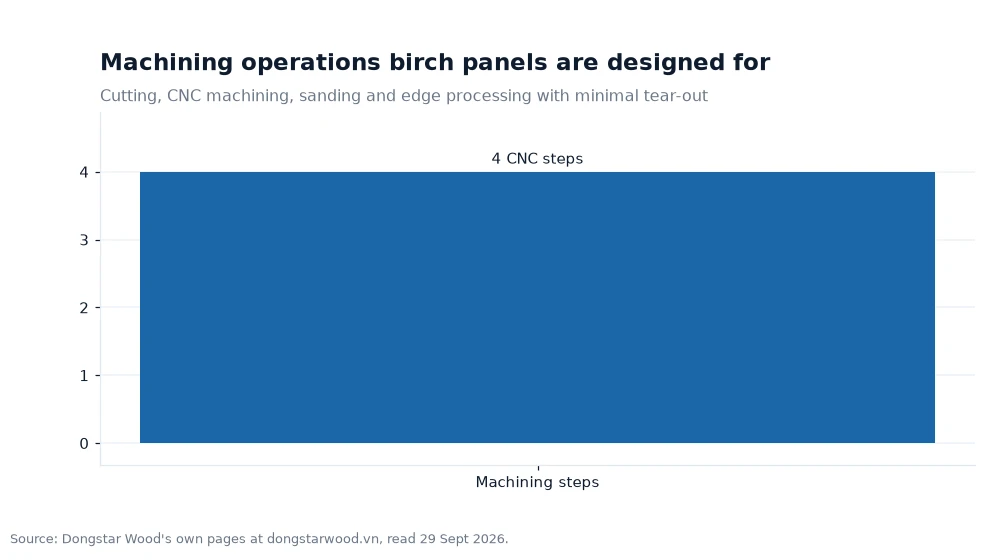
The product page describes a multi-layer hardwood core built to resist warping during machining, and panels that hold clean edges and flat faces through cutting, sanding and edge processing. That sentence is the reason birch is specified for furniture and joinery rather than for rough work: the panel has to survive the CNC machine and the cutting table as well as the container, and it has to come out of each with minimal tear-out.
Moisture control and panel tolerance for European climates complete the picture. A panel that is cut to tolerance in a humid workshop and shipped to a dry climate will move, and the movement shows up as gaps in joinery and bowed panels. The published tolerance and moisture control are the buyer's protection against that movement, and they are worth confirming in the specification because they are the two figures a workshop cannot fix after delivery.
Compliance options: E1, CARB P2 and CE documentation
The page names E1, CARB P2 and CE documentation as compliance options, with low-emission glue systems behind them. For a European buyer the CE documentation covers the construction product side; for a US buyer CARB P2 addresses the emission limits that apply to composite wood products; E1 appears as the baseline emission class across markets. The glue system is the same conversation wearing a regulatory costume: low-emission glues are specified because the panels end up in interiors where the air quality matters.
Waterproof options are listed as phenolic or melamine adhesives, which is the choice for panels that will meet water during their service life rather than during shipping. The distinction matters at the specification stage: a phenolic-bonded panel and an E1 panel are different products with different jobs, and the compliance documentation that travels with each one is different too.
| Input | Published position | What it protects |
|---|---|---|
| Packing | Protective wrapping, steel strapping, wooden pallets | Edges and faces through the journey |
| Face grades | A, B, C and repaired-defect | Appearance against the finish specified |
| Thickness range | 2.7 mm to 30 mm | The right panel for the job, not a compromise |
| Compliance | E1, CARB P2, CE documentation | Market access and interior air quality |
| Bonding | Phenolic or melamine options | Service life where water is present |
Worked example: pack coverage and offcuts
Example: a standard 1220 × 2440 mm sheet spans 1.22 m × 2.44 m = 2.9768 m². A pack of thirty sheets therefore carries 30 × 2.9768 = 89.304 m² of panel, and the pallet that holds it has to be sized and strapped for that stack rather than for a single sheet.
Example: the same sheet area checks the offcuts. A furniture shop cutting 0.6 m × 0.6 m = 0.36 m² parts from a 2.9768 m² sheet gets 2.9768 ÷ 0.36 = 8.27, so eight parts per sheet with 0.0968 m² of offcut. Both steps are planning estimates on published sizes, labelled as examples, and they show why the sheet size and the packing standard have to be fixed before the order is placed.
Frequently asked questions
Which face grade should furniture panels be?
The product page lists A-grade as outstanding condition with some knots and burls allowed, B-grade with larger burls, additional knots and some colour variation, and C-grade as smooth and sound with even more variation. The grade follows the finish the panel will receive.
What packing does an export order use?
The product page names the standard directly: every export pack is wrapped, steel-strapped and mounted on a wooden pallet, with custom packaging and labelling available for large projects. Edge protection matters most on long sea routes.
Which compliance documents can accompany birch panels?
The page names E1, CARB P2 and CE documentation, with low-emission glue systems. Ask for the certificate that matches the market the panels are sold into.
From the pack to the workshop
A birch purchase is protected in two ways: once through the packing and once through the specification. The okoume product page shows the lighter decorative option for the same workshop, and the company's own profile details the factory and the certification portfolio behind both. With the packing standard, the face grade and the compliance documents fixed, the panels that arrive at the workshop are the panels that were ordered.
Statistics quoted above were sourced from Dongstar Wood's own site on 29 Sept 2026[1].