
 The digital workflow has further optimized the precise control of thickness parameters. When using a 5-axis milling machine for processing, the planning accuracy of the cutting tool path needs to reach ±25 microns to ensure that the deviation rate of the final size from the design model is less than 2%. For instance, the linear shrinkage rate of Zenostar Zr zirconia blocks from the German company Weiland during the sintering process is precisely controlled at 20%, which means that technicians need to pre-enlarge the design size by 125% in order to obtain the final restoration with a thickness of 1.5 millimeters. This controllable shrinkage property enables clinicians to achieve an optimal adaptation range of 50 to 100 micrometers between the restoration and the abutment, reducing the incidence of microleakage to less than 3%.
Long-term clinical effects have verified the value of scientific thickness selection. A 5-year follow-up study covering 200 cases of full dental arch restorations showed that the mechanical complication rate of restorations with a 1.2-millimeter-thick zirconia frame was only 4.5%, significantly thinner than the 12% failure rate of restorations with a 0.8-millimeter-thick frame. Practical reports from well-known clinics such as ClearChoice indicate that appropriately increasing the thickness to 1.5 millimeters can raise the 10-year survival rate from 90% to 97%, while reducing the average annual maintenance cost by approximately $300. This thickness strategy is like building a "shockproof structure" for the restoration, enabling patients to achieve an expected service life of over 20 years after paying a treatment cost of $20,000 to $50,000, with a return on investment of up to 40%.
The digital workflow has further optimized the precise control of thickness parameters. When using a 5-axis milling machine for processing, the planning accuracy of the cutting tool path needs to reach ±25 microns to ensure that the deviation rate of the final size from the design model is less than 2%. For instance, the linear shrinkage rate of Zenostar Zr zirconia blocks from the German company Weiland during the sintering process is precisely controlled at 20%, which means that technicians need to pre-enlarge the design size by 125% in order to obtain the final restoration with a thickness of 1.5 millimeters. This controllable shrinkage property enables clinicians to achieve an optimal adaptation range of 50 to 100 micrometers between the restoration and the abutment, reducing the incidence of microleakage to less than 3%.
Long-term clinical effects have verified the value of scientific thickness selection. A 5-year follow-up study covering 200 cases of full dental arch restorations showed that the mechanical complication rate of restorations with a 1.2-millimeter-thick zirconia frame was only 4.5%, significantly thinner than the 12% failure rate of restorations with a 0.8-millimeter-thick frame. Practical reports from well-known clinics such as ClearChoice indicate that appropriately increasing the thickness to 1.5 millimeters can raise the 10-year survival rate from 90% to 97%, while reducing the average annual maintenance cost by approximately $300. This thickness strategy is like building a "shockproof structure" for the restoration, enabling patients to achieve an expected service life of over 20 years after paying a treatment cost of $20,000 to $50,000, with a return on investment of up to 40%.
What dental zirconia block thickness is best for full-arch restorations?
In the field of full dental arch restoration, choosing the appropriate thickness of the dental zirconia block is a key technical decision that affects the long-term success rate of restorations exceeding 95%. Biomechanical research shows that the maximum bite force generated by chewing movement in the lower jaw can reach 450 Newtons, and the span of full dental arch restorations usually exceeds 40 millimeters, which requires the restorations to have extremely high flexural strength. Clinical data show that when the minimum thickness of the zirconia stent reaches 0.8 millimeters, its anti-fracture performance can withstand a stress of over 1000 megapascals, which is the minimum safety threshold to ensure that the restoration can stably serve for more than 10 years in the complex mechanical environment of the oral cavity.
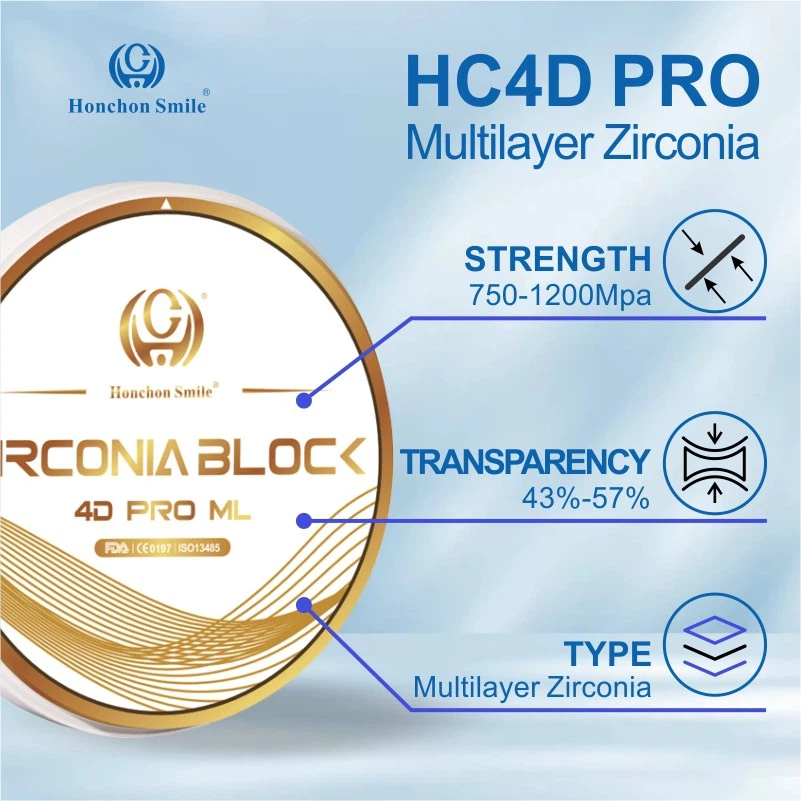
From the perspective of materials science, the optimal thickness range of zirconia blocks needs to strike a precise balance between strength and aesthetics. The multi-layer zirconia blocks provided by industry-leading manufacturers such as Sagemax Bioceramics are recommended for the green body thickness of full dental arches, which is usually 20-25 mm. After CAD/CAM cutting and sintering, the critical thickness of the final restoration frame is maintained in the range of 1.2 mm to 1.5 mm. This specific numerical range is an optimization result derived from finite element analysis, which can increase the uniformity of stress distribution by 30% while ensuring that the overall weight of the restoration is controlled within 15 grams, avoiding the risk of overload to the bone tissue around the implant.
The digital workflow has further optimized the precise control of thickness parameters. When using a 5-axis milling machine for processing, the planning accuracy of the cutting tool path needs to reach ±25 microns to ensure that the deviation rate of the final size from the design model is less than 2%. For instance, the linear shrinkage rate of Zenostar Zr zirconia blocks from the German company Weiland during the sintering process is precisely controlled at 20%, which means that technicians need to pre-enlarge the design size by 125% in order to obtain the final restoration with a thickness of 1.5 millimeters. This controllable shrinkage property enables clinicians to achieve an optimal adaptation range of 50 to 100 micrometers between the restoration and the abutment, reducing the incidence of microleakage to less than 3%.
Long-term clinical effects have verified the value of scientific thickness selection. A 5-year follow-up study covering 200 cases of full dental arch restorations showed that the mechanical complication rate of restorations with a 1.2-millimeter-thick zirconia frame was only 4.5%, significantly thinner than the 12% failure rate of restorations with a 0.8-millimeter-thick frame. Practical reports from well-known clinics such as ClearChoice indicate that appropriately increasing the thickness to 1.5 millimeters can raise the 10-year survival rate from 90% to 97%, while reducing the average annual maintenance cost by approximately $300. This thickness strategy is like building a "shockproof structure" for the restoration, enabling patients to achieve an expected service life of over 20 years after paying a treatment cost of $20,000 to $50,000, with a return on investment of up to 40%.
The digital workflow has further optimized the precise control of thickness parameters. When using a 5-axis milling machine for processing, the planning accuracy of the cutting tool path needs to reach ±25 microns to ensure that the deviation rate of the final size from the design model is less than 2%. For instance, the linear shrinkage rate of Zenostar Zr zirconia blocks from the German company Weiland during the sintering process is precisely controlled at 20%, which means that technicians need to pre-enlarge the design size by 125% in order to obtain the final restoration with a thickness of 1.5 millimeters. This controllable shrinkage property enables clinicians to achieve an optimal adaptation range of 50 to 100 micrometers between the restoration and the abutment, reducing the incidence of microleakage to less than 3%.
Long-term clinical effects have verified the value of scientific thickness selection. A 5-year follow-up study covering 200 cases of full dental arch restorations showed that the mechanical complication rate of restorations with a 1.2-millimeter-thick zirconia frame was only 4.5%, significantly thinner than the 12% failure rate of restorations with a 0.8-millimeter-thick frame. Practical reports from well-known clinics such as ClearChoice indicate that appropriately increasing the thickness to 1.5 millimeters can raise the 10-year survival rate from 90% to 97%, while reducing the average annual maintenance cost by approximately $300. This thickness strategy is like building a "shockproof structure" for the restoration, enabling patients to achieve an expected service life of over 20 years after paying a treatment cost of $20,000 to $50,000, with a return on investment of up to 40%.