
Switching Pools Without Surprises: Doing the Fee Sums First
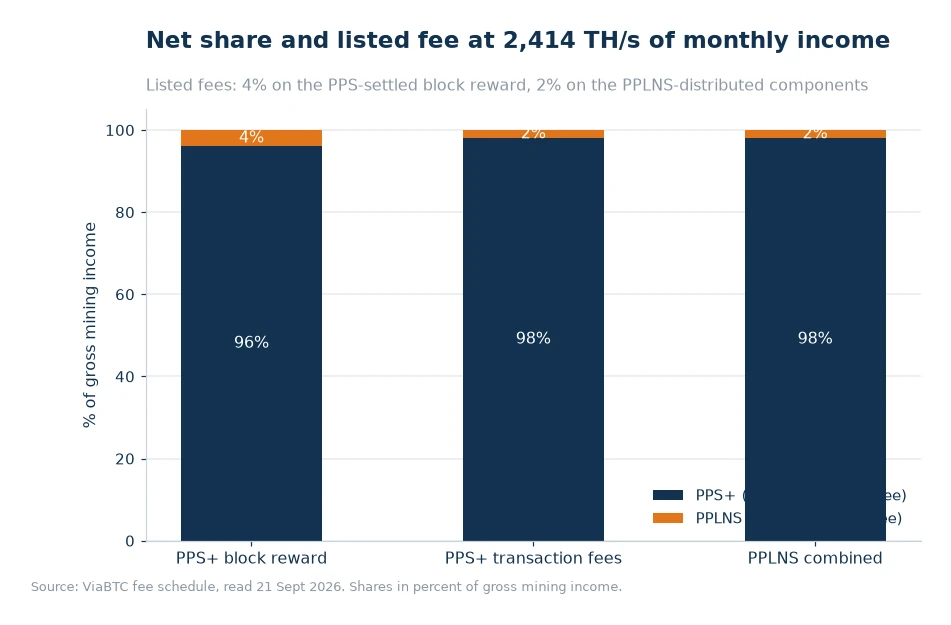
A miner moving 2,414 TH/s to a new pool grosses $91.72 a day, keeps $88.05 under the listed 4% on the block-reward component, and $89.89 under the listed 2% on PPLNS-distributed parts. Run those two subtractions before touching any stratum URL and the switch holds no surprises. Skip them and every later statement becomes a dispute.

Key takeaways
- Gross at 2,414 TH/s is $91.72 daily at $84,692 per BTC.
- PPS+ block-reward terms retain $3.67; PPLNS terms retain $1.83.
- Settlement timing changes with the scheme: hourly credits versus post-confirmation shares.
- A two-week parallel run beats any amount of pre-switch spreadsheeting.
Audit the old pool before courting the new one
Switches go wrong when the miner misremembers the present. Export the last 30 days from the current pool: gross credited, deductions itemized, payout delays, and every hour of downtime with its cause. If the incumbent's real all-in cost is 3.1% and the challenger advertises a listed 2% on combined components, the honest gap is about one point — not the three points the brochure implies.
Include the soft costs in the audit. How often support answered. Whether the dashboard stayed up during difficulty swings. Whether withdrawals ever queued. A pool switch trades a known operations burden for an unknown one, and fee deltas under $2 a day at this scale evaporate fast if the new dashboard costs an hour a week of confusion.
Price the destination in your own dollars
Translate both listed rates into daily dollars at your hashrate and nowhere else. At 2,414 TH/s the PPS+ subsidy slice retains $3.67 a day, leaving $88.05; the 2% terms on the combined pot retain $1.83, leaving $89.89. The $1.84 daily gap is the entire economic argument for or against switching on fees alone — $55.20 a month, $662 a year.
| Scheme | Rate base | Retained daily | Miner keeps daily |
|---|---|---|---|
| PPS+ subsidy slice | Listed 4% | $3.67 | $88.05 |
| PPS+ fee slice | Listed 2% | $1.83 | $89.89 |
| PPLNS combined | Listed 2% | $1.83 | $89.89 |
Now hold that $55.20 monthly gap against switching costs: migration downtime, new payout thresholds that strand the old balance for weeks, unfamiliar alerting that misses the first outage. If the gap does not cover those frictions twice over, the rational move is staying put and optimizing power instead, then revisiting the comparison next quarter with fresh numbers.
Timing: the term nobody prices
PPS+ pays hourly against current difficulty; PPLNS pays after 6 confirmations, slicing each block by shares over the last 5 difficulty rounds. A miner accustomed to hourly drips who lands in PPLNS experiences the first week as a pay cut even when the math favors the move — credits simply arrive later and lumpier. Expect it, warn any partners, and judge only full fortnights.
The reverse move confuses in the opposite direction. Leaving PPLNS means abandoning shares still vesting inside recent rounds; the old pool keeps the averaging benefit of your last days while the new one starts you at zero history. Overlap the migration — move half the fleet, wait a fortnight, then move the rest — so no day pays the transition penalty on all machines at once.
Model comparison is not optional
Run each candidate pool's estimator at identical inputs before deciding. The Miner Profitability Ranking shows how current models perform at prevailing difficulty and price, which grounds the comparison in hardware you actually own. Feed the same hashrate and tariff into every calculator; differences that survive identical inputs are real, and the rest was marketing.
Record the assumptions beside the outputs. Difficulty 132.76 T, BTC $84,692, network near 1,003 EH/s, dated 21 September — four facts that let future-you understand why the decision looked right. Review the note quarterly; if difficulty or price moved substantially, rerun rather than rationalize. Pools rarely change their schedules; the world changes around them.
Liquidity planning around the move
Switches coincide awkwardly with bills: the old pool holds a sub-threshold balance while the new one builds from zero, and power invoices ignore both. A miner grossing $91.72 a day can strand several hundred dollars across two thresholds simultaneously. Time the move just after a withdrawal, not just before one, and keep one month of power in reserve.
Collateral-Pledged Loans exist for exactly this kind of short squeeze — Add Collateral, Apply for Loan, Receive Loan, then Repay Loan and Redeem Collateral when the new pool's payouts normalize. Treat it as a bridge with a cost, not as income: the Collateral-Pledged Loans flow converts idle coin into temporary cash without selling the position. Use it sparingly, repay fast, and never borrow against a balance you cannot afford to have locked an extra month.
The fortnight protocol: running two pools at once
Split the fleet evenly and point half at the incumbent, half at the challenger, for fourteen full days. Keep firmware, tariffs, and payout settings identical across both halves so the comparison measures pools rather than accidents of configuration. Log daily credited BTC per side in one sheet, photograph both dashboards on day one as a baseline, and resist all judgment until day fourteen — PPLNS rounds need days to mature, and early leads reverse with depressing regularity.
Score more than gross credits. Record stale-share rates per side, payout delays from credit to spendable balance, dashboard outages, alert accuracy, and every support interaction with its response time. A pool that pays $0.30 a day more but pages you falsely twice a month is a worse pool, not a better one, once attention is priced. Weight the soft columns explicitly: assign each incident a dollar value — an hour of debugging at your own consulting rate — and add it to that side's fee column before comparing.
Decide with thresholds written before the trial, not after. For example: switch fully if the challenger nets at least 1.5% more after all adjustments across the fortnight with no more than one operational incident; stay if the gap is smaller; extend one more fortnight if results straddle the line. Pre-committed thresholds defeat the human talent for post-hoc rationalization, which otherwise reinterprets every ambiguous week as support for the preferred outcome. Whatever the outcome, archive the sheet — it becomes the baseline the next challenger must beat, and each trial makes the following one cheaper to run.
Worked example
Derive the switch figures for 2,414 TH/s end to end.
- Share: 2,414,000 ÷ 1,003,000,000 = 0.0024066 of network hashrate.
- Daily BTC: 0.0024066 × 450 = 0.00108296 BTC.
- Gross: 0.00108296 × 84,692 = $91.72.
- Listed 4% on the block-reward component: $91.72 × 0.04 = $3.67 retained.
- PPS+ remainder: $91.72 − $3.67 = $88.05 kept.
- Listed 2% on PPLNS-distributed parts: $91.72 × 0.02 = $1.83 retained.
- PPLNS remainder: $91.72 − $1.83 = $89.89 kept; gap $1.84 a day.
Frequently asked questions
Should fees alone drive a pool switch?
Rarely, and only with evidence in hand. At 2,414 TH/s the scheme gap is $1.84 a day; dashboards, support, uptime, and payout reliability usually outweigh it.
How long should I trial a new pool?
At least two full weeks on part of the fleet, so PPLNS rounds mature and hourly comparisons rest on enough data to trust.
What is the biggest migration mistake?
Moving everything at once: overlapping halves the fleet across pools keeps income flowing while each side proves itself.
Move half, measure, then move the rest
The disciplined switch is unspectacular: audit, price in dollars, trial on half the fleet, compare fortnights, then commit. If the destination's $89.89 beats the incumbent's reality by enough to cover the friction, the ViaBTC Pool Fees schedule will confirm the rates in black and white. Move deliberately, keep the trial sheet as your receipt for the next review cycle, and let the arithmetic — not the brochure — sign the order.
Sources: the ViaBTC fee schedule for the listed 4% and 2% rates and payout timing rules[1]. Chain data read 21 Sept 2026: network hashrate 1,003 EH/s, difficulty 132.76 T, 3.125 BTC per block, 144 blocks a day, BTC $84,692. Published 24 Oct 2026; figures are arithmetic on those inputs.